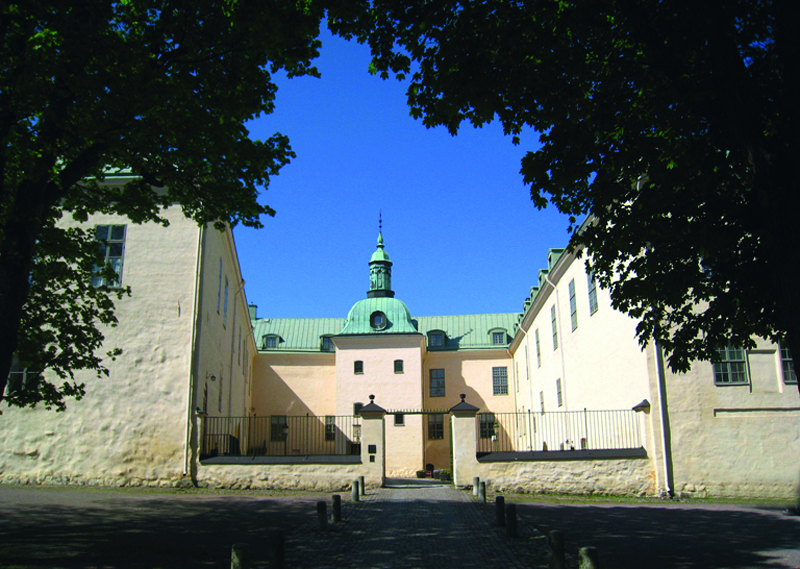
CASTLE - AND CATHEDRAL MUSEUM LINKÖPING

The museum is situated in the North wing of Linköping Castle. During recent archaeological excavations it was discovered that the earliest parts of the castle date back to the 12th Century. It is possible that it is the oldest secular building in Sweden. The diocese of Linköping was established at the beginning of the 12th Century. The oldest parts of the castle, now incorporated in the West wing, were built as the Bishop´s residence. They consisted of two storey limestone building and a detached limestone cellar.  In 1286 Bengt Birgersson was made Bishop. He was the brother of the king, Magnus Ladulås, and the youngest son of Birger Jarl, one of the most influential men in Sweden. Bengt Birgerson built a residential tower to the East of the original buildings. The five store tower with a crenelated roof was one of the first buildings in Östergötland to be made of bricks. The facade can be seen to the right of the entrance hall. In the early 15th Century additions were made by Bishop Knut Bosson, a third floor was added to the limestone house. The Catholic bishops of Linköping were involved in the power struggles with the King and aristocracy that were frequent during the Middle Ages. It was therefore necessary to fortify the buildings and to keep a small army for defence. An encircling wall with a wall walk was built in the 1480:s. After the reformation of the Church in 1527, Linköping´s Catholic Bishop, Hans Brask, fled to Poland. The king, Gustav Vasa, immediately confiscated the property belonging to the Church and the Bishop. The castle was modernised, the ceilings were heightened and large renaissance windows installed. During the reign of Gustav Vasa´s son, Johan III, a three storey wing was added to the South. The entire third floor of the wing was one great hall. A roofed, wooden gangway connected the South and North wings and the outside of the castle was painted white with red borders around the doors and some of the  windows. In particular the windows on the third floor of the South wing were richly decorated. The high shingle roof was red tarred. Heavily decorated renaissance gables were added in the early 1600´s. In the great fire of 1700, after witch most of Linköping was laid in ruins, the city prison was destroyed. The castle, now empty and in a state of disrepair, was suitable as a replacement. The East part of the castle was therefore converted into a jail.The last years of the 18th  Century saw the transformation of the renaissance castle into an austere official building. Today it is the residence of the Country Governor.  

THE TOWER ROOM

This is the ground floor of the residential tower built by bishop Bengt Birgersson in the 1280:s. Two models show the early stages in the construction of the bishop’s residence. The first model shows the 12th Century two storeyed limestone building. The second model shows the residence after the brick tower was erected in the 13th Century. In the far corner the original medieval staircase can be seen. To the left of the staircase a wooden door opened out towards the Cathedral. The oak stump in the opposite corner was used as a chopping block for the preparation of food. The 35 kilos of bone material that were found in the vicinity reveal the diet of the Bishop and his household. The mediaeval style painting on the wall shows some of the animals and fish from which bones were found. Two mumified black rats from the 15th Century were discovered by archaeologists in the Bishop’s privet. They are on display in a small case by the chopping block. 

THE ENTRANCE HALL

This was the castle laundry room in the 19th Century. Two large washtubs were placed on either side of the fireplace. Channels in the floor (now covered) were used to lead away dirty water. Fragments of the original wall colour were found under several layers of modern paint. A painting of a man in profile, traditionally called Bishop Brask, which was also discovered on the wall is now used as the museum’s logotype.  

THE FIRST FLOOR

Two cases at the top of the stairs show mediaeval finds from archaeological excavations in Linköping. Between the windows a section of the wall has been left unplastered. Repairs and addictions from different periods are outlined. Large grey stones belong to an encircling wall from the 15th Century and a part of the wallwalk has been reconstructed.  The treasury contains vestments and church plate from the Cathedral. The earliest of the vestments were embroidered by nuns from the Birgittine convent in Vadstena in the early 15th Century. 

THE TOP FLOOR

A model to the left at the top of the stairs shows the bishops residence as it was in the 1480:s after additions were made to the West and the South by Bishop Henrik Tidemansson. The large model in the middle of the room shows the castle in 1604 when it had been a royal residence for almost one hundred years. It was transformed into a renaissance palace during the reign of king Karl IX.  Funeral escutcheons on the wall illustrate a Swedish tradition. From the 16th to the 18th  Centuries it was customary that these escutcheons were carried in the funeral processions of  the aristocracy. After the burial they were placed on the walls in the church.The stone carved in relief are mediaeval originals from the Cathedral that were removed  and replaced by copies during a renovation in the 1870:s. Originally they were placed on the tympanum of the South portal. 

THE VASA ROOM      

The last Catholic bishop to live in the residence, Hans Brask, is in the middle of an animated discussion with his guest king Gustav Vasa on Christmas day 1523. although surviving documents from Bishop´s household tell us what was on the menu, we have no idea what was discussed. It is likely that the topic of conversation was the king´s poor finances. Perhaps Gustav Vasa´s plans to reform the Church were also discussed, as Hans Brask was his greatest adversary. In the case by the window, findings from the Bishop´s kitchen are on display. His household consisted of some 60 people, from farmhands and soldiers to kitchen staff, scriveners and his personal barber (see the painting on the wall). 

Opening hours and entrance fees

Tuesday to sunday: Noon - 4 pm

mondays and major church holidays - closed

Adults: 50 Skr
Retirees and students: 40 Skr
Children/youth 7-18 år: 20 Skr
Children 0-7: free

Contact

Linköpings Slotts- och Domkyrkomuseum
Borggården
582 28 Linköping, Sweden

Phone

+46 (0)13 12 23 80

Fax

+46 (0)13-14 23 80

Mail

info@lsdm.se